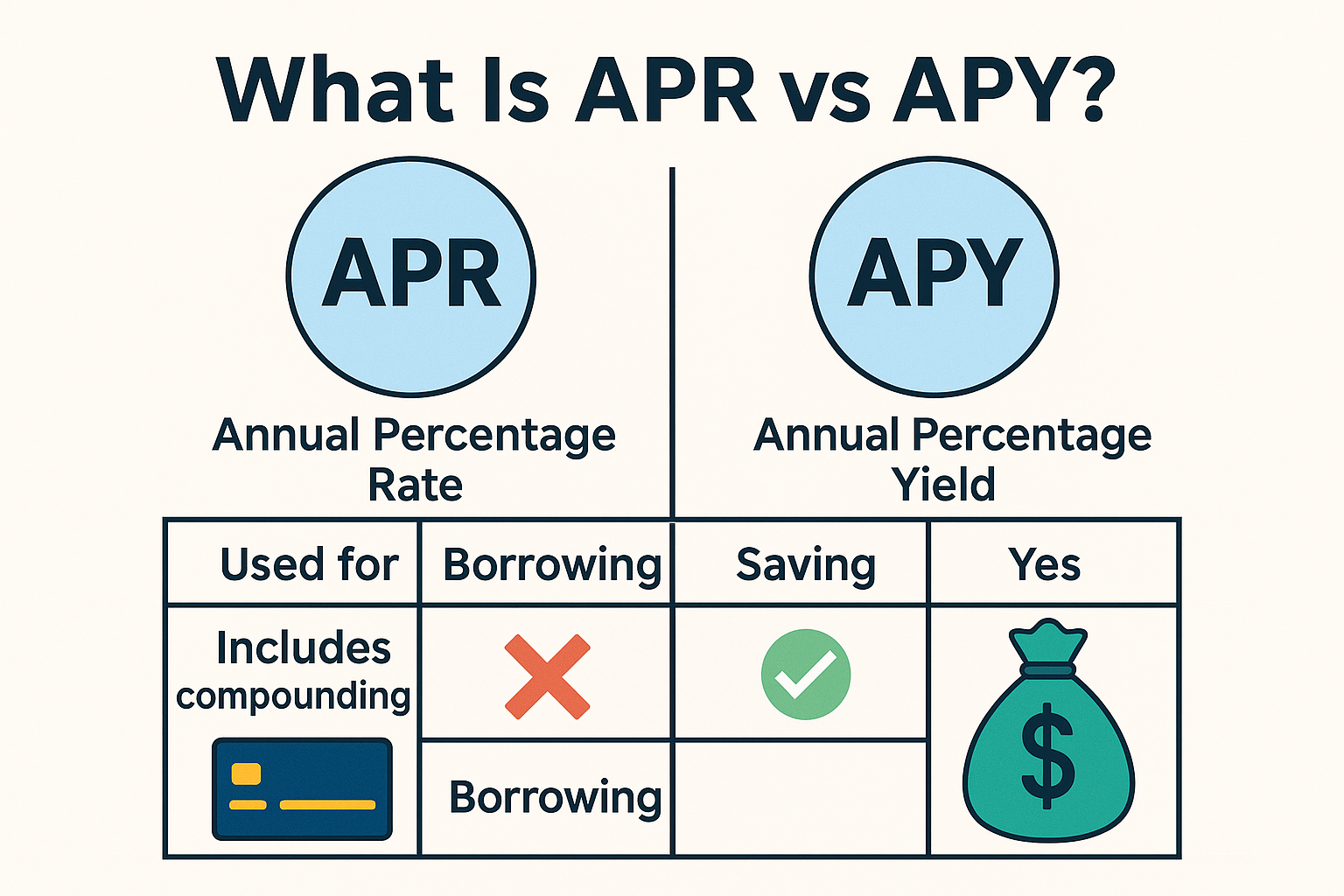
If you’ve ever opened a credit card or savings account, you’ve probably seen the terms APR and APY. They look similar — but they mean very different things.
Understanding the difference can save you thousands of dollars over time.
Let’s break it down in the simplest way possible.
📌 What Is APR?
APR (Annual Percentage Rate) represents the yearly cost of borrowing money.
It’s commonly used for:
Credit cards Personal loans Auto loans Mortgages
🔹 Key points about APR:
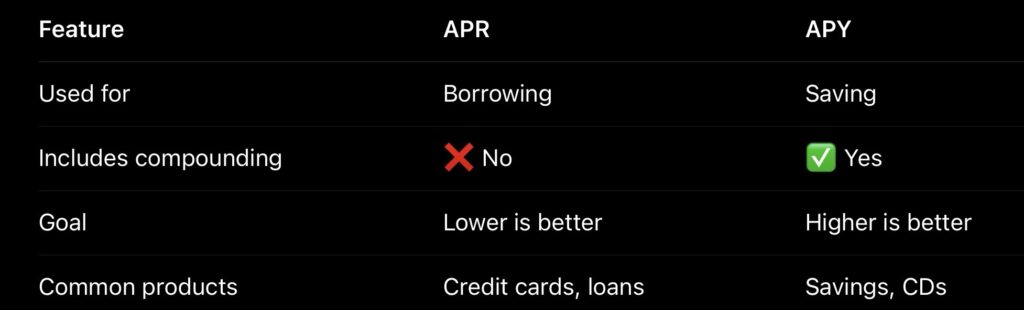
Shows how much interest you pay per year Does not include compound interest Lower APR = cheaper debt
👉 Example:
If a credit card has a 20% APR, you’re paying roughly 20% per year on your balance.
📌 What Is APY?
APY (Annual Percentage Yield) represents how much interest you earn on savings or investments including compound interest.
It’s used for:
Savings accounts High-yield savings CDs Money market accounts
🔹 Key points about APY:
Includes compound interest Higher APY = more money earned Compounding can be daily, monthly, or yearly
👉 Example:
A savings account with 4.5% APY earns more than 4.5% simple interest because of compounding.
⚔️ APR vs APY: What’s the Difference?
💡 Why This Difference Matters
If you:
Borrow money → focus on APR Save or invest → focus on APY
Many people lose money simply because they don’t understand this distinction.
📈 Real-Life Example
Credit card: 22% APR → expensive debt Savings account: 4.8% APY → money grows passively
Using high-APY accounts while avoiding high-APR debt is one of the smartest financial moves you can make.
🧠 Final Thoughts
APR tells you how much debt costs.
APY tells you how much your money earns.
Knowing the difference helps you:
Choose better financial products Avoid unnecessary debt Grow your savings faster
Financial literacy starts with small concepts like this — and they make a huge difference long-term.
About The Author