What’s going on with instant payments in the U.S.
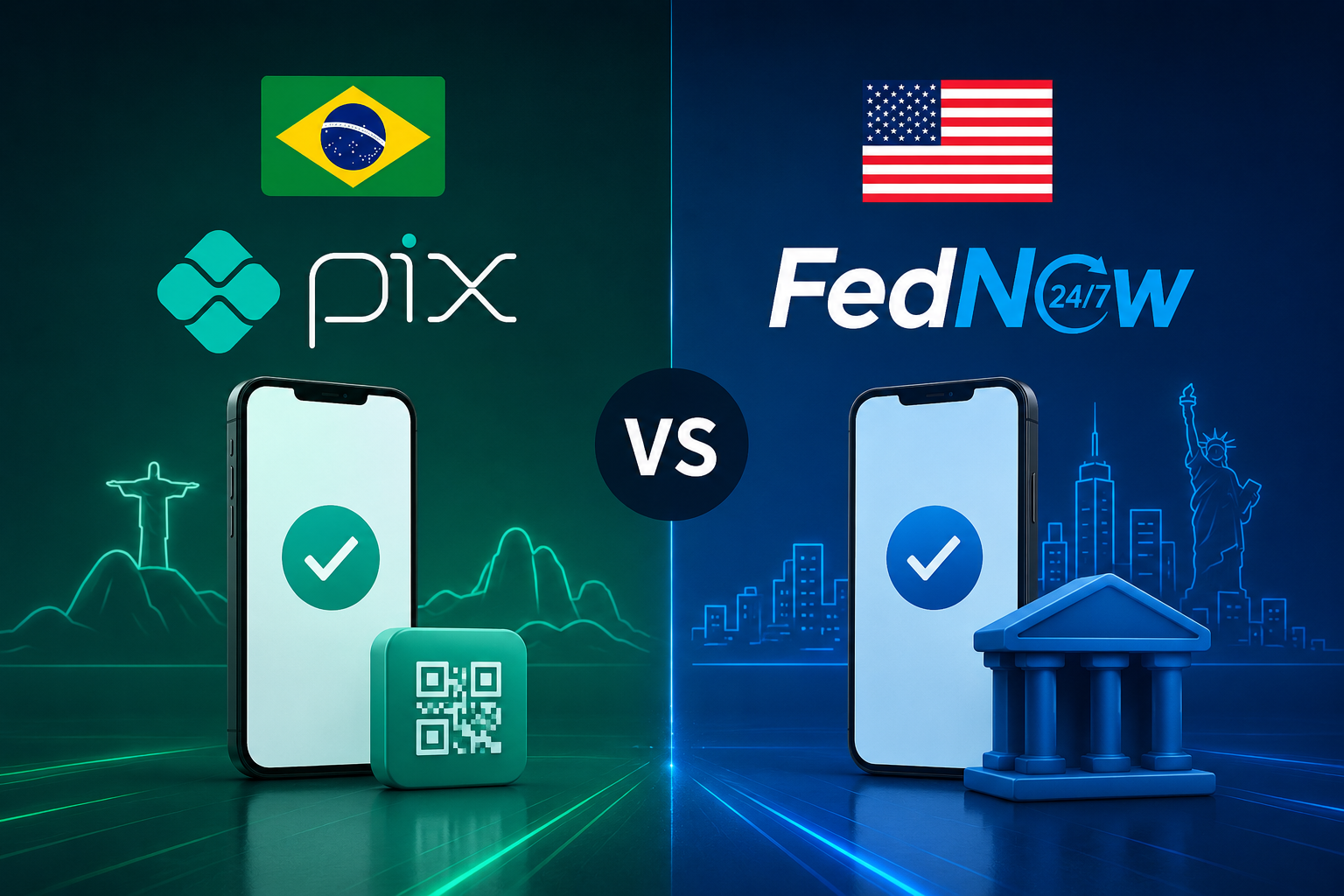
In recent years, many people started saying that the United States is “creating an American PIX.” This comparison comes from a new payment system called FedNow, which is very similar in concept to Brazil’s PIX.
However, the U.S. is not copying PIX directly. Instead, it is building its own real-time payment infrastructure to modernize the banking system.
What is PIX in Brazil?
The Banco Central do Brasil launched PIX in 2020 as an instant payment system.
PIX allows:
- Transfers in seconds
- 24/7 availability
- Low or zero fees for individuals
- Payments using keys (phone, email, ID, etc.)
It completely changed how money moves in Brazil.
What is the “American PIX” (FedNow)?
In the United States, the closest equivalent is FedNow, created by the Federal Reserve System.
FedNow enables:
- Instant bank-to-bank transfers
- 24/7 real-time settlement
- Faster financial operations between institutions
It was designed to modernize a system that previously relied on slower banking processes.
Key differences between PIX and FedNow
Even though they are similar, they are not the same system.
PIX (Brazil)
- Centralized by the central bank
- Widely used by individuals and businesses
- Direct user-friendly system
FedNow (United States)
- Focused mainly on banks and financial institutions
- Adoption is still expanding
- Works more as backend infrastructure rather than a direct app for users
Will the U.S. have something exactly like PIX?
Not exactly.
The U.S. already has a similar system in terms of function, but the structure is different. FedNow is more decentralized in terms of user access, relying on banks to build interfaces for customers.
Global trend in payments
Worldwide, the direction is clear:
- Cash usage is declining
- Instant digital payments are becoming standard
- Central banks are upgrading financial infrastructure
PIX’s success in Brazil has actually influenced other countries to speed up similar systems.
Final thoughts
The United States is not copying PIX, but FedNow serves the same purpose: faster, real-time money transfers.
The global financial system is evolving toward a future where sending money is as fast and simple as sending a message.
About The Author