
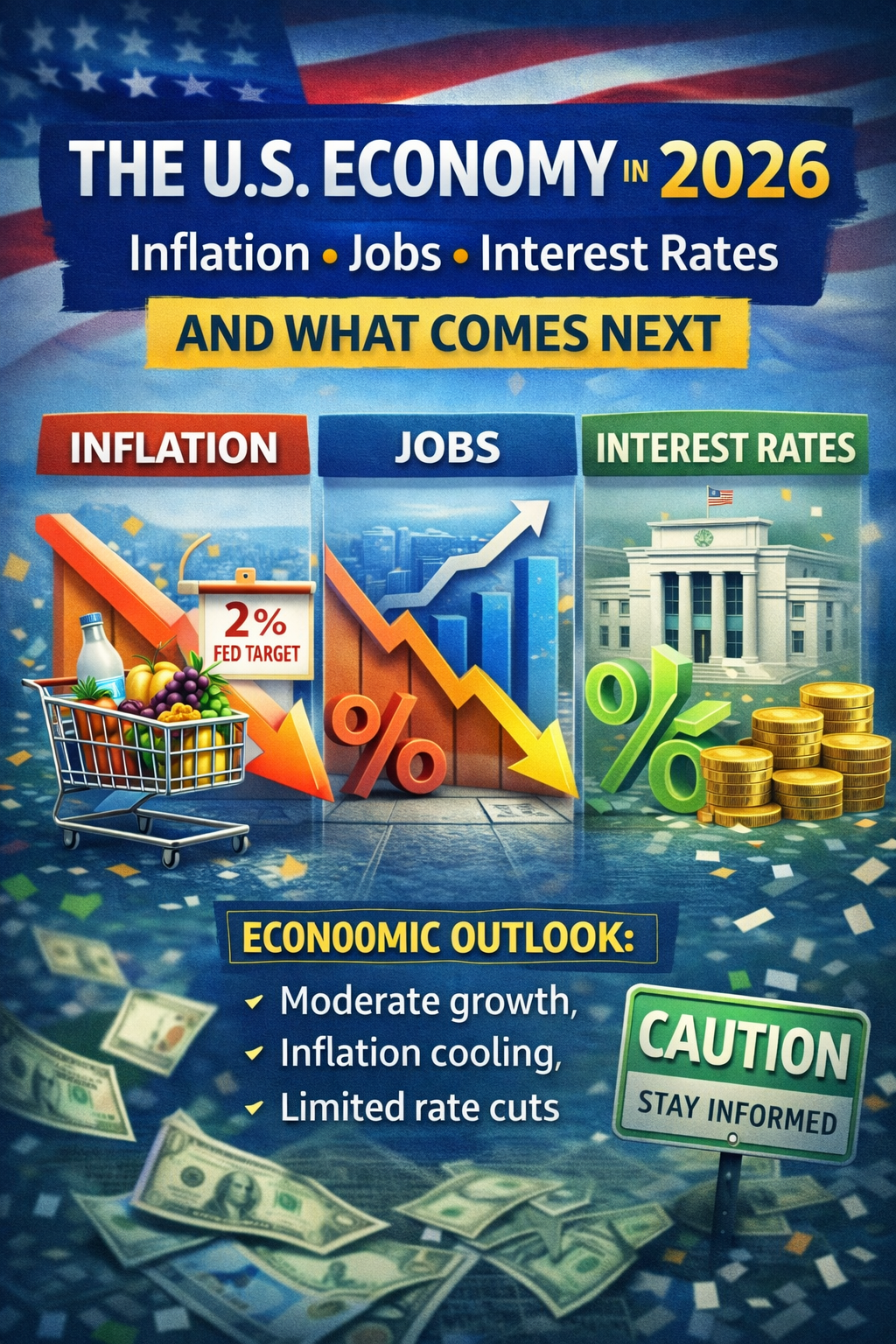
As 2026 begins, the United States economy stands at a crucial crossroads. After years marked by high inflation, aggressive interest rate hikes, and economic uncertainty, new data suggests a shift toward stabilization — though not without challenges.
Inflation is easing, the labor market is cooling, and the Federal Reserve is navigating a delicate balance between supporting growth and keeping prices under control.
📉 Inflation: Slowing, but Not Fully Under Control
Inflation in the U.S. has continued to moderate, offering some relief to consumers. While price growth is no longer surging at the levels seen in previous years, inflation still sits above the Federal Reserve’s 2% target.
Essential costs such as housing, healthcare, and services remain elevated, meaning households still feel pressure — especially middle- and lower-income families. However, the downward trend signals progress and reduces the need for aggressive monetary tightening.
💼 Labor Market: Cooling Without Collapsing
The U.S. job market remains relatively strong, but momentum has slowed. Hiring has softened, job openings have declined, and wage growth is stabilizing.
This cooling is not necessarily bad news. In fact, it is part of the Fed’s goal: reducing inflation without triggering mass unemployment. So far, the economy appears to be heading toward a soft landing, though risks remain if conditions weaken too quickly.
📉 Interest Rates: What the Federal Reserve Is Signaling
After a historic cycle of rate hikes, the Federal Reserve has shifted to a more cautious stance. Policymakers have indicated that interest rates are now at levels restrictive enough to control inflation.
Markets are pricing in limited and gradual rate cuts in 2026, depending on future inflation and employment data. Any cuts are likely to be slow, as the Fed wants to avoid reigniting inflationary pressures.
For consumers, this could mean:
Slightly cheaper loans and mortgages over time Improved credit conditions Gradual recovery in business investment
📊 Markets and Investors: Cautious Optimism
Financial markets are responding with measured optimism. Stocks remain sensitive to economic data releases, while bond markets are adjusting to expectations of future rate cuts.
Investors are focusing on:
Inflation reports (CPI, PCE) Employment data Fed communications and policy meetings
Volatility remains part of the landscape, reinforcing the importance of long-term planning over short-term speculation.
🏠 What This Means for Everyday Americans
For households and workers, the economic outlook suggests:
More stable prices compared to recent years Gradual easing of borrowing costs A job market that is still healthy, but more competitive Greater importance of budgeting and financial planning
While the worst inflation shock appears to be behind, financial discipline remains essential.
🔮 Outlook for the Rest of 2026
The U.S. economy is not heading into a boom — but it is also not in crisis. The most likely scenario is moderate growth, declining inflation, and careful monetary adjustments.
Much will depend on:
Global economic conditions Energy prices Consumer spending Federal Reserve policy decisions
✅ Final Thoughts
The U.S. economy in 2026 is transitioning from turbulence to stability. Inflation is cooling, the labor market is rebalancing, and interest rates may slowly decline. For consumers, workers, and investors alike, staying informed and adaptable will be the key to navigating the year ahead.
About The Author