Even in 2026, one of the most powerful drivers of global financial markets is still often misunderstood: interest rates.
Central banks don’t just influence borrowing costs — they shape capital flows, stock market valuations, currency strength, and even crypto cycles.
Understanding interest rates is essentially understanding where money wants to go.
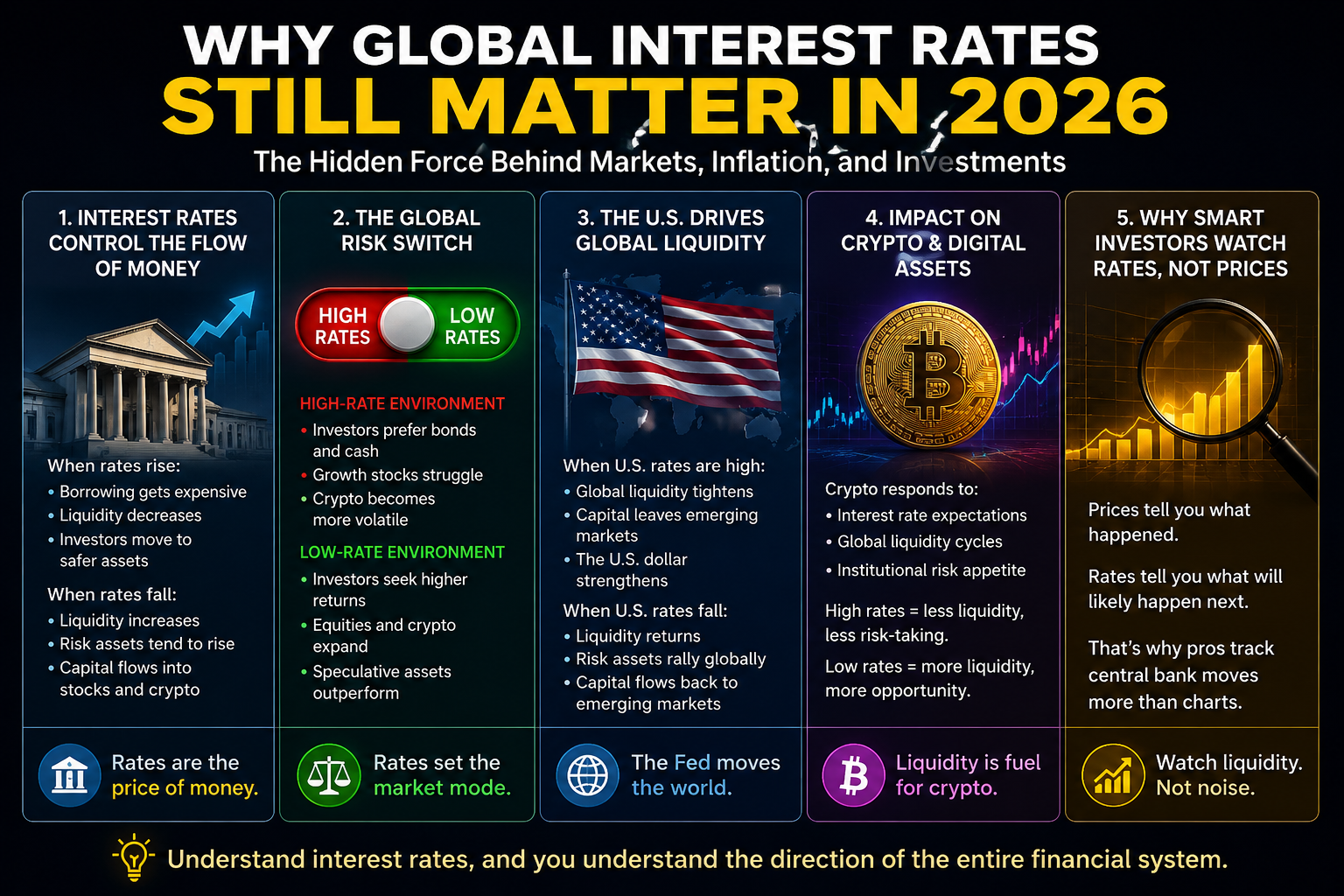
What interest rates actually control
Interest rates, set by central banks like the Federal Reserve and the Banco Central do Brasil, act as the price of money.
When rates rise:
- borrowing becomes more expensive
- liquidity in markets decreases
- investors move toward safer assets
When rates fall:
- liquidity increases
- risk assets tend to rise
- capital flows into stocks and crypto
This simple mechanism drives nearly every major market cycle.
The global “risk switch” effect
Interest rates act like a global switch between two modes:
High-rate environment
- investors prefer bonds and cash-like assets
- startups and growth stocks struggle
- crypto becomes more volatile
Low-rate environment
- investors seek higher returns
- equities and crypto expand
- speculative assets outperform
This is why markets often move in cycles that feel emotional — they are actually structural.
Why the U.S. still dominates global liquidity
The U.S. dollar remains the world’s reserve currency. That means decisions made by the Federal Reserve affect nearly every country.
When U.S. rates are high:
- global liquidity tightens
- emerging markets experience capital outflows
- the U.S. dollar strengthens
When U.S. rates decrease:
- liquidity returns to global markets
- risk assets tend to rally worldwide
Impact on crypto and digital assets
The crypto market is extremely sensitive to liquidity conditions.
Assets like Bitcoin tend to respond strongly to:
- interest rate expectations
- global liquidity cycles
- institutional risk appetite
In high-rate environments, investors demand more yield and reduce exposure to speculative assets. In low-rate environments, capital flows back into growth and high-volatility markets.
Why investors watch rates more than prices
Professional investors don’t focus only on asset prices — they focus on liquidity direction.
Because:
Price tells you what happened. Rates tell you what will likely happen next.
That’s why macro traders track central bank speeches more closely than charts.
Interest rates are not just financial tools — they are the foundation of global capital movement.
The decisions made by institutions like the Federal Reserve and the Banco Central do Brasil determine:
- where money flows
- what assets outperform
- and how long market cycles last
In modern finance, understanding rates is understanding the direction of the entire system.
About The Author